Finger Stuck and Clicking? Orthopedic Specialist Dr. Hsu Fang-Wei Explains the Causes and Treatment of “Trigger Finger”!

Hsu Fang-wei (Orthopedic Surgeon at Jianli Clinic) | Orthopedic Specialist License No. 002188

2026-03-26
Lately, in my clinic, I often see middle-aged women rush in, looking panicked, pointing to the middle joint of their finger and asking, “Doctor, is my finger joint dislocated? It keeps making strange noises!” Actually, this isn’t a dislocation—it’s “trigger finger,” a very common condition in orthopedic clinics!
To help dispel this misconception, this article will guide you through the causes, key symptoms, and practical care tips. Follow these steps from an orthopedic doctor to help your stuck finger regain its freedom!
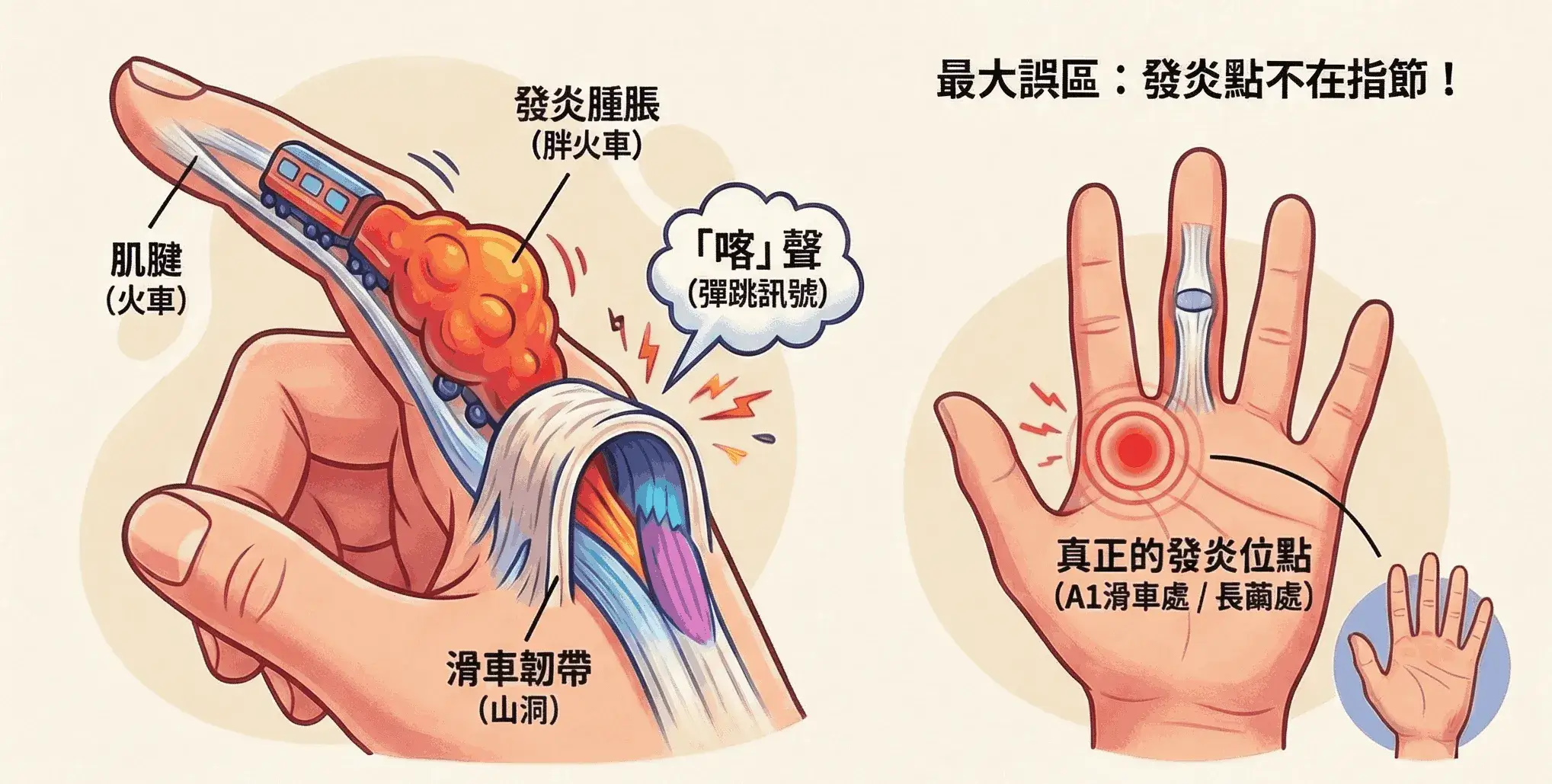
What is trigger finger? Why does the finger get stuck? (The "Fat Train Through a Tunnel" Theory)
Our finger tendons are like a train, and the "pulley ligaments" on the bones are like tunnels that hold the tendons in place. When we overuse our fingers—such as when gripping objects, scrolling on our phones, or doing housework—the tendons become inflamed and swollen. At this point, it’s as if a “bulky train is trying to pass through a tunnel that was originally designed for a smaller train”; naturally, it gets stuck and can’t get through.
Common Symptoms and Major Misconceptions About Trigger Finger | A Look at the 4 High-Risk Groups
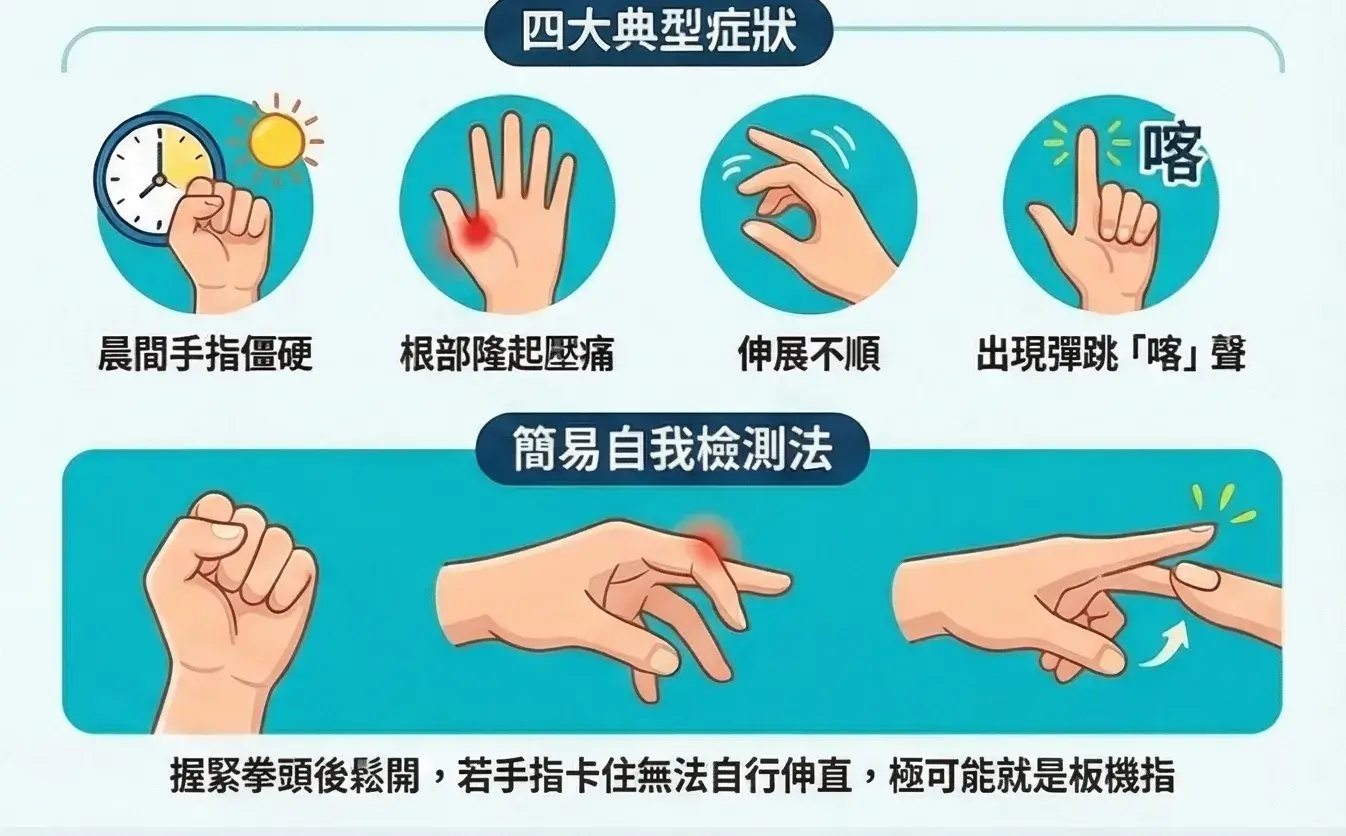
Many people assume it’s a problem with the finger joints, but the actual site of inflammation and stiffness is located where calluses form on the palm (near the base of the fingers). Pressing on this area is extremely painful, which is a common misconception.
High-risk groups include women going through menopause or pregnancy, as well as patients with diabetes and rheumatoid arthritis. Additionally, professionals whose work involves repeatedly bending their fingers—such as computer users, cleaning staff, hairdressers, and dentists—are particularly susceptible, with the condition most commonly affecting the thumb, middle finger, and ring finger.
Quick Self-Check: Do I Have Trigger Finger?
Clench your fist tightly and then release it. If your fingers get stuck and won’t straighten smoothly—or if you even need to use your other hand to help pull them apart—and this is accompanied by a “click-clack” snapping sound, you likely have trigger finger.
What to Do About Trigger Finger? An Orthopedic Surgeon’s Step-by-Step Treatment Plan
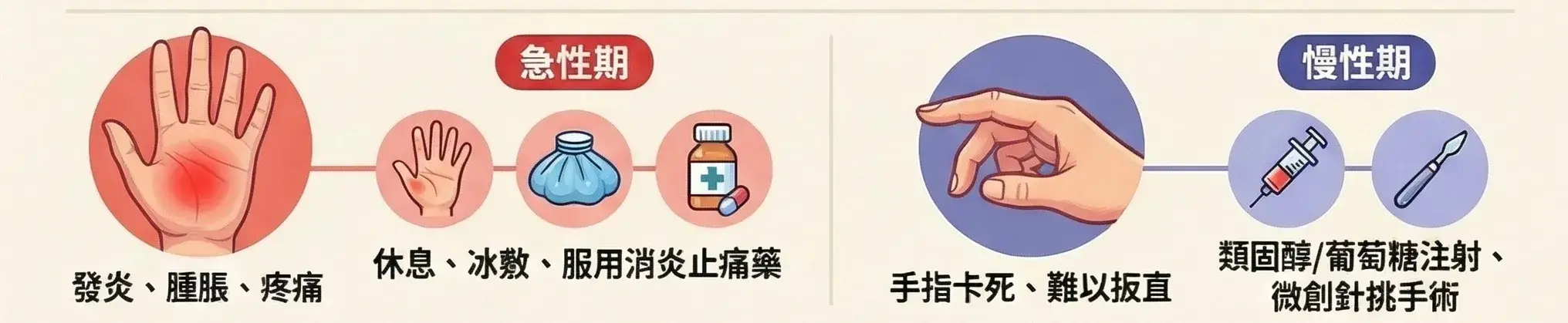
1. Acute and Chronic Phases: Rest and Conservative Treatment
When inflammation and swelling first occur, the first step is rest! You can apply ice to reduce inflammation or take pain relievers, and use a splint to immobilize the finger, allowing it to “rest” and stop overuse. If the finger remains bent for an extended period and cannot be straightened, consider heat therapy, paraffin baths, shockwave therapy, or a local injection of a low-concentration glucose solution by a physician to improve adhesions.
2. Local Steroid Injections
If symptoms are severe, a local steroid injection is an effective treatment that can rapidly reduce inflammation, with a success rate of approximately 60%.
3. Sutureless Minimally Invasive Release Surgery (Needle Release)
If symptoms persist and recur for more than three months without improvement, I would recommend “percutaneous minimally invasive release (needle release).” Under ultrasound guidance, a special needle is used to open the narrowed tunnel. The incision is only the size of a needle hole, requiring no sutures or removal of stitches. You can go home with just a band-aid, and your finger will return to its natural position immediately after the procedure.
Dr. Xu's Trigger Finger Guide: Daily Prevention and Post-Minimally Invasive Surgery Rehabilitation
Many patients ask me, “Dr. Xu, I don’t want to end up needing surgery. How can I prevent this from happening in the first place? And if I do end up having surgery, how should I go about my rehabilitation?” Here are some practical self-care tips and exercises:
No Surgery Required! Daily Relief and Rubber Band Stretches
- Stretching in the Opposite Direction: When tendinitis causes your finger to get stuck, use your other hand to gently stretch the finger in the “opposite direction of the stiffness.” This helps relax the overly tense, inflamed tissue and reduces local inflammation.
- Elastic Band Strength Training: Find an elastic hair tie or rubber band, loop it around your thumb and the other fingers, and pull it back and forth with force. Perform 12 to 15 repetitions per set. This exercise effectively stretches the flexor tendons, restoring muscle elasticity and flexibility.
Don’t Let Your Tendons Adhere Again! The Golden Period for Rehabilitation After Minimally Invasive Surgery
Many people think that once the surgery is over, they’re in the clear—but that’s a huge mistake! Minimally invasive surgery simply “opens up the passageway”; if you don’t combine it with stretching exercises after the procedure, the tendons may still adhere again. If you’ve just had minimally invasive surgery, rehabilitation is essential—it’s the key to real improvement!
- In addition to icing the surgical site, you must perform “slow upward finger stretches” every day.
- Remember, you must push through the pain and use your unoperated hand to help straighten it; you should also practice bending the middle phalanges to a 90-degree angle to form a fist.
- Perform this at least 6 times a day for 10 minutes each session to prevent the tissues from adhering again.
A friendly reminder from Dr. Hsu: Our hands are the tools we use most frequently every day. If you experience “stiff fingers upon waking” or “clicking sounds during movement,” please give your fingers a break immediately!If your “fat train” really gets stuck in the tunnel and can’t get out, don’t force it—seek professional help as soon as possible. From rest and injections to minimally invasive surgery, we have a comprehensive treatment plan to help resolve your issues. Take good care of your hands so you can continue to handle life’s big and small tasks with ease!
[Disclaimer] This article was compiled by Dr. Hsu Fang-wei based on evidence-based medical literature and is intended to provide health education information. Actual treatment methods, dosages, and efficacy vary from person to person. Please be sure to visit a medical facility in person so that a physician can conduct a professional assessment and diagnosis based on your individual condition.
Further Reading:
(Free Health Network): https://health.ltn.com.tw/article/breakingnews/5340109 Trigger Finger: A Three-Step Treatment Approach, Like a "Train Stuck in a Tunnel"
Related Articles
CASE Testimonials Mrs. Chen had previously undergone total knee replacement surgery on her right knee. Fully aware of the hardships of the recovery period, she was extremely reluctant to undergo another operation despite suffering from severe osteoarthritis in her left knee, and could only endure th
orthopedics Orthopedic pain Wrist and fingers Please enter a title here Table of Contents Does your finger get stuck and snap back with a "click"? It might not be due to aging—it could be "trigger finger" | From causes and symptoms to treatment and prevention, learn everything yo