AGF Amniotic Growth Factors Injection

Regen Health
2025-11-26
Amniotic Growth Factor Injections: A New Generation of Regenerative Therapy That Overcomes the Limitations of PRP
In the field of modern regenerative medicine, amniotic membrane injection therapy has emerged as a highly promising non-surgical treatment. This technique primarily utilizes natural components extracted from human placental amniotic membranes to promote the repair of damaged joints and tendons.
What is Amniotic Growth Factor Injection?
Amniotic growth factor injections are not painkillers or steroids in the traditional sense, but rather a bioactive scaffold. They are typically derived from the amniotic membrane of the placenta of healthy cesarean section donors, and proprietary dehydration technologies such as PURION® are used to preserve the active components they contain.
The core of this therapy lies in its full embodiment of the “three elements of tissue repair” in regenerative medicine:
- Signals: Contains over 285 types of growth factors (such as PDGF, VEGF, and TGF-β), which are responsible for stimulating cells to divide and regenerate.
- Scaffold: It preserves the extracellular matrix (ECM), which contains collagen, providing a “scaffold” for new cell growth and reducing scar formation.
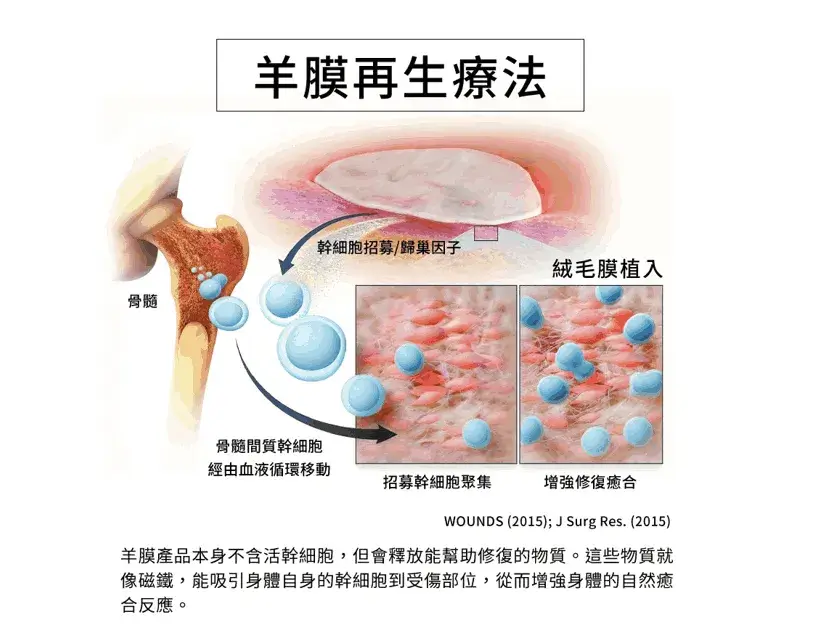
- Cell Recruitment: Through chemokines, it attracts the body’s own mesenchymal stem cells (MSCs) to migrate to the damaged site for synergistic repair.
Amniotic Growth Factors: Evidence from International Journals (Evidence-Based Medicine)
The following data from recent international peer-reviewed medical journals confirm the outstanding clinical performance of amniotic fluid injections.
1. Efficacy for plantar fasciitis: A randomized
controlled trial (RCT) published in *Foot & Ankle International* indicates:
- Study Design: To compare the efficacy of amniotic fluid injections versus traditional steroid injections in treating refractory plantar fasciitis.
- Results: Patients who received amniotic fluid injections experienced an average reduction of over 70% in their pain score (VAS) 12 weeks after treatment, and their foot function index (FI) was significantly better than that of the control group.
- Conclusion: For patients unresponsive to conventional conservative treatments, amniotic fluid injections provide more lasting therapeutic effects without the risk of plantar fat pad atrophy associated with steroids.
2. Efficacy
for "Knee Osteoarthritis" According to a study published in *The Journal of Knee Surgery* (2016):
- Study Details: Dehydrated amniotic/chorionic membrane (dHACM) injections were administered to multiple patients with knee osteoarthritis.
- Results: Following a single injection, patients demonstrated significant improvements in both the WOMAC (Knee Pain Index) and VAS (Pain Index) within 3 months, with effects persisting for over 12 months.
- Conclusion: Amniotic membrane contains tissue inhibitor of metalloproteinases (TIMPs), which effectively suppress inflammation and protect cartilage from further wear and tear.
Beyond PRP? A Comparison of Amniotic Growth Factors and PRP
| Comparison Criteria | PRP (Autologous Platelet-Rich Plasma) | Amniotic Growth Factor (Amniotic Allograft) |
|---|---|---|
| Source | Autologous blood (blood draw required) | Allogeneic placenta (no blood draw required; sterile-processed) |
| Growth Factor Concentration | Varies depending on the patient’s age and physical condition (less effective in older patients) | Standardized fixed dosage, high and stable concentration |
| Components | Platelets, growth factors | Over 285 types of growth factors + collagen scaffold (ECM) |
| Anti-inflammatory effect | Initially triggers an inflammatory response to initiate repair (may cause some pain) | Powerful anti-inflammatory effects, containing the anti-inflammatory factor IL-1Ra (less painful) |
| Number of sessions | Typically requires 3–6 sessions | Usually only 1–2 sessions |
| Suitable for | Younger individuals, sports injuries, those with good blood quality | Elderly individuals, those with severe degeneration, those for whom PRP treatment has been ineffective, and those who are afraid of blood draws |
Treatment Protocol and Indications for Amniotic Hyperplasia
Main Indications:
- Chronic Pain: Plantar fasciitis, tennis elbow, golfer’s elbow, Achilles tendonitis.
- Degenerative Joint Conditions: Knee osteoarthritis (most effective in stages 2–3), rotator cuff injuries of the shoulder.
- Difficult-to-heal conditions: Non-union of fractures, diabetic foot ulcers.
Three-Step Standard Treatment Protocol:
- Assessment: The physician uses X-rays or advanced ultrasound to determine the depth of the lesion and the extent of soft tissue damage.
- Injection: The entire procedure is ultrasound-guided. This is crucial for precisely injecting the precious amniotic powder (mixed with saline) into the damaged fascia or joint cavity while avoiding nerves and blood vessels. The process takes only 5 minutes.
- Recovery: You can walk immediately after the procedure. It is recommended to avoid strenuous exercise for 3–7 days to allow the scaffold to stabilize within the body and release its growth factors.
Short-term Postoperative Care and Contraindications for Medications
In the initial period following the injection, the body initiates a "repair-oriented inflammatory" response. At this stage, the focus of care is on protecting the injection site and avoiding any suppression of growth factor activity.
- Activity Recommendations: There is no need to rest after the procedure; you may walk immediately. However, it is recommended to avoid strenuous exercise (such as running, weight training, or long-distance hiking) for 3–7 days (or one week) following the procedure to allow the bio-scaffold to stabilize within the body and continue releasing growth factors.
- Normal Reactions: You may experience mild soreness, tightness, or pain at the injection site within 2–3 days after the procedure. This is a normal physiological response as the tissue initiates repair (benign inflammation), so please do not be overly concerned.
- Physical Management: If you experience soreness or swelling, you may apply intermittent cold compresses (10–15 minutes at a time) to reduce local swelling.
Medication Contraindications (Most Important)
To ensure the success of regenerative therapy, extreme caution must be exercised regarding medication, particularly when selecting pain relievers.
- Strong anti-inflammatory drugs (NSAIDs) are strictly prohibited: After surgery, avoid using nonsteroidal anti-inflammatory drugs such as ibuprofen and naproxen.
- Reason for prohibition: Regenerative therapy relies on “repair-oriented inflammation” to rebuild tissue; potent anti-inflammatory drugs suppress the inflammatory response, thereby reducing the reparative effects of growth factors.
- Alternative options: If pain is significant, it is recommended to consult a physician to switch to pain relievers without anti-inflammatory effects (such as Tylenol/acetaminophen).
Amniotic Growth Factors FAQ
Q1. If PRP didn’t work for me, would Amniotic Growth Factors therapy be effective?
The effectiveness of PRP depends on the patient’s blood quality (it tends to be less effective in older patients or those with chronic conditions). Amniotic growth factors are standardized, high-concentration formulations that typically include an ECM scaffold—which PRP lacks—providing a more stable environment for tissue repair.
Q2. How long does it take to feel the effects? How many sessions are needed?
- Short-term (1–2 weeks): Significant reduction in pain (anti-inflammatory effect).
- Long-term (3–6 months): Continued tissue regeneration.
- Number of sessions: Most patients see results after just one session; those with severe conditions may require a booster treatment after 3 months.
Q3. Is there a risk of rejection or allergic reactions? The risk is extremely low.
Amniotic membrane possesses unique “immune-privileged” properties, making it unlikely to trigger immune rejection. The manufacturing process complies with U.S. FDA and AATB standards, ensuring extremely high safety.
Q4. Can I receive the treatment if I am taking anticoagulants (such as aspirin)?
Yes. Since amniotic membrane injections do not require the withdrawal of the patient’s own blood, patients taking anticoagulants, those with anemia, or those with fragile blood vessels can safely undergo treatment without needing to discontinue their medication.
Q5. Does it contain “live stem cells”?
It does not contain live cells. Instead, it provides over 285 types of growth factors and protein scaffolds that act like “magnets,” attracting and activating the body’s own stem cells to the damaged area for repair.
Q6. Is the injection painful? How long does recovery take?
The procedure takes only 5 minutes. It uses ultrasound-guided precision injection, and the sensation is similar to that of a regular injection. No hospitalization is required after the procedure; you can walk immediately, but you should avoid strenuous exercise for one week.
Q7. Can I take anti-inflammatory medication after the procedure?
It is recommended to avoid them. Do not take strong anti-inflammatory pain relievers (NSAIDs, such as ibuprofen), as regenerative therapy relies on the body’s natural “repair-oriented inflammation” to rebuild tissue, and strong anti-inflammatory drugs can inhibit this effect.
Q8. Besides the knee, which other areas are suitable?
Primarily for chronic pain:
- Feet: Plantar fasciitis, Achilles tendinitis.
- Hands: Tennis elbow, golfer’s elbow.
- Shoulder: Rotator cuff injuries.

Related Articles
CASE Testimonials Mrs. Chen had previously undergone total knee replacement surgery on her right knee. Fully aware of the hardships of the recovery period, she was extremely reluctant to undergo another operation despite suffering from severe osteoarthritis in her left knee, and could only endure th
Regenerative Medicine Integrative Medicine Regenerative Therapy Please enter a title here Table of Contents Turning On the Body’s Repair Switch: How Does BMAC (Autologous High-Concentration Bone Marrow Concentrate) Reshape the Joint Microenvironment? Have you ever wondered why, even after multiple